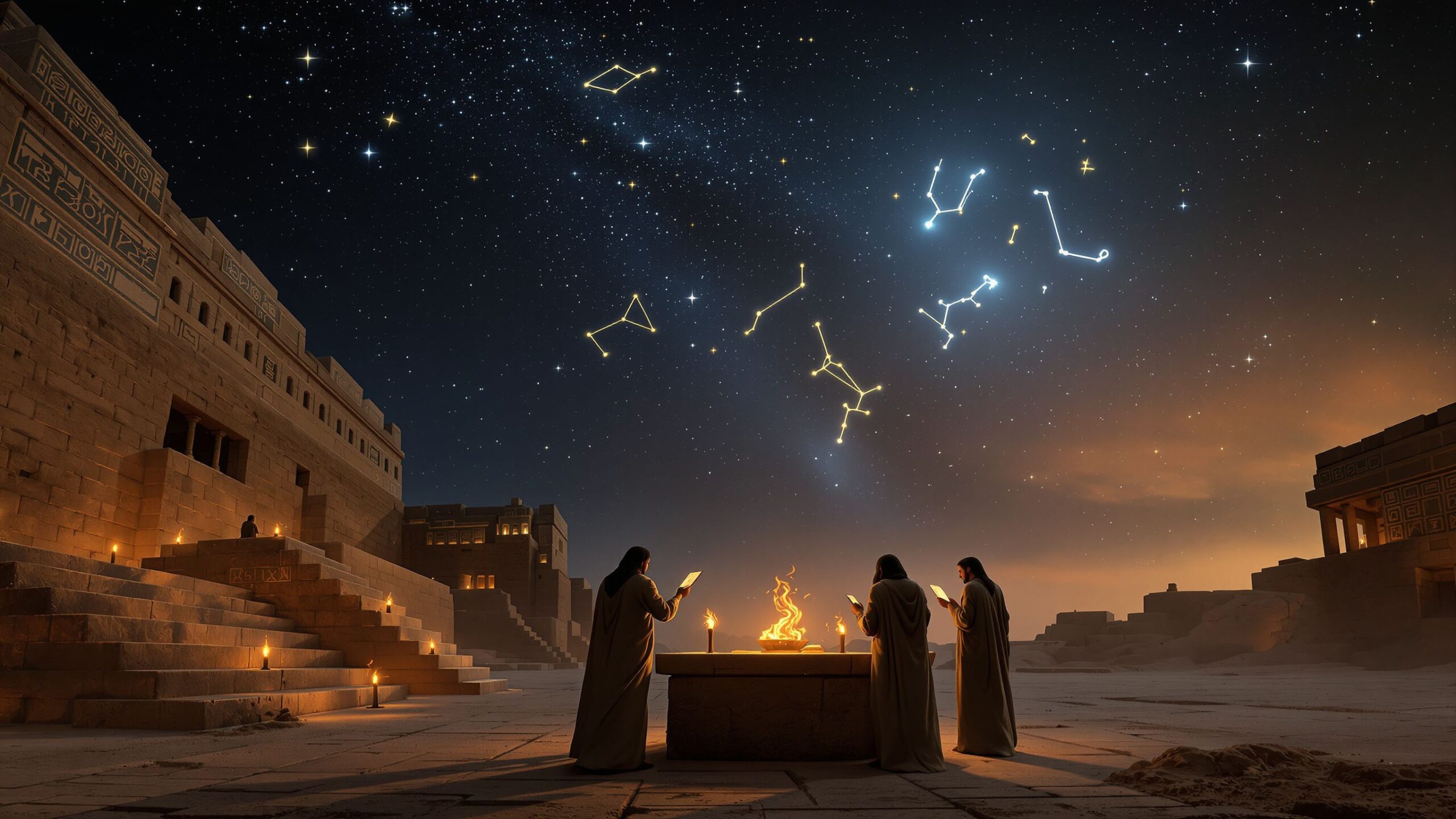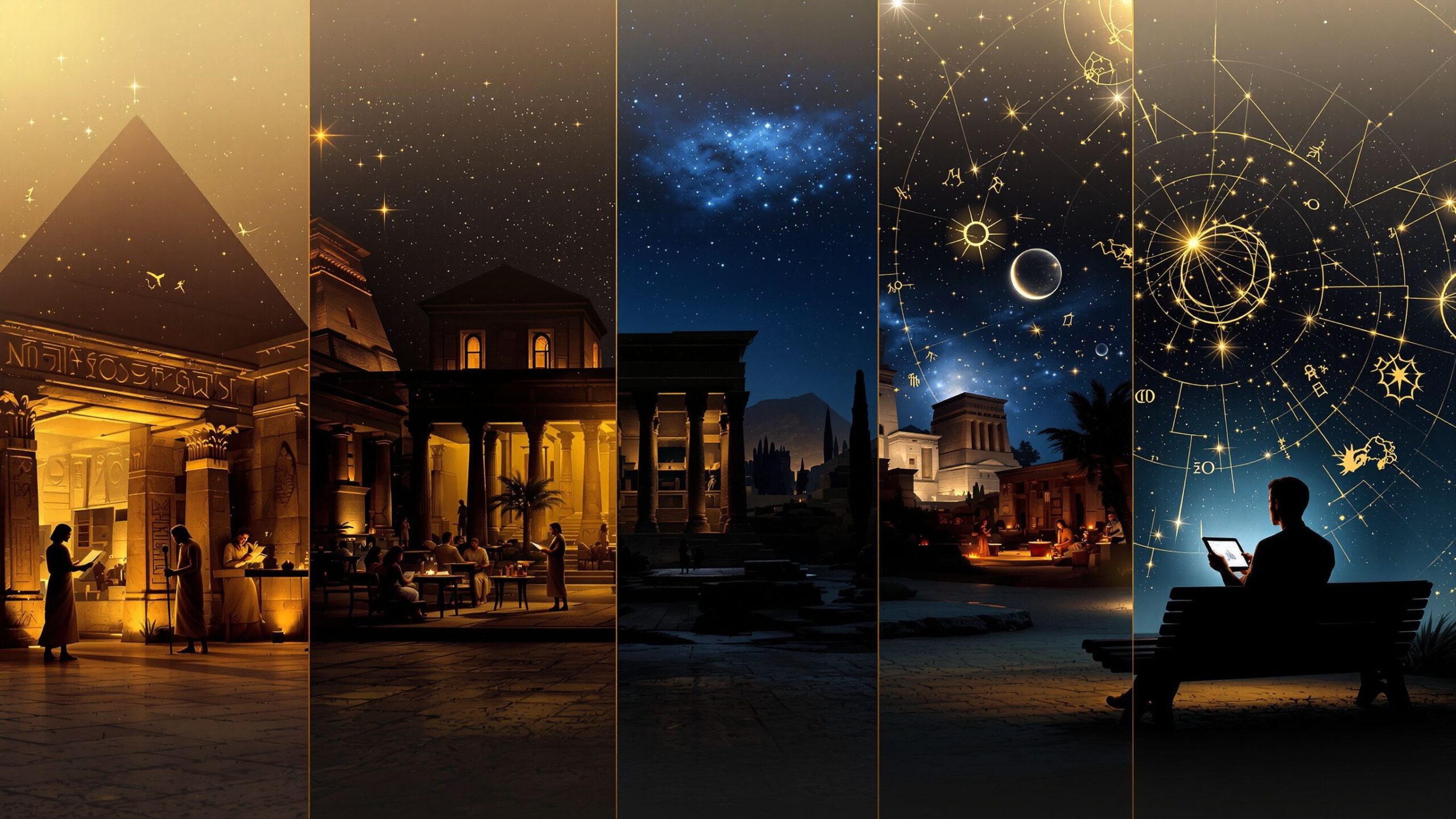
The zodiac did not appear overnight as a finished system of signs and meanings. It was born slowly, shaped by centuries of observation, imagination, and a deep human need to understand the universe. Long before horoscopes became part of daily life, ancient civilizations were already studying the sky with remarkable precision. They were not simply watching the stars for beauty—they were searching for patterns, messages, and meaning. The zodiac emerged from this pursuit, becoming one of humanity’s earliest and most enduring attempts to connect the cosmos with life on Earth.
A: It developed from ancient Mesopotamian sky observation, especially Babylonian astronomy and omen traditions.
A: They used the sky to understand time, seasons, divine messages, political events, and natural cycles.
A: The 12-sign system was shaped mainly by Babylonian astronomers and later refined by Greek astrology.
A: The word is connected to a Greek phrase meaning a circle or belt of animals.
A: The ecliptic is the Sun’s apparent yearly path across the sky.
A: No. Signs are equal symbolic divisions, while constellations are uneven star patterns.
A: In ancient times they were intertwined, with sky observation serving both practical and symbolic purposes.
A: Animals and mythic figures helped ancient cultures turn star patterns into memorable symbols.
A: Personal birth-chart astrology became more developed in the Hellenistic period.
A: It remains popular because it connects ancient history, identity, symbolism, myth, and cosmic wonder.
The First Sky Watchers and Their Curiosity
In the earliest days of civilization, the night sky served as both a mystery and a guide. Without artificial light, ancient people experienced the stars in their full brilliance. They noticed that certain stars appeared to move across the sky in predictable ways, while others remained fixed. Over time, these patterns became familiar, and people began to recognize recurring celestial events.
This curiosity led to the first forms of astronomy, though it was deeply intertwined with spirituality. The sky was not seen as separate from human life. Instead, it was believed to influence everything from weather patterns to personal destiny. Observing the heavens became a way to understand the forces shaping existence.
Early civilizations across the world—from Mesopotamia to Egypt, from India to China—developed their own systems for interpreting the sky. While these systems differed in detail, they shared a common goal: to find order in the vastness above.
Mesopotamia: The Birthplace of the Zodiac
The true origins of the zodiac can be traced to ancient Mesopotamia, often called the cradle of civilization. It was here, among the Babylonians, that the first structured zodiac system began to take shape. As early as the second millennium BCE, Babylonian scholars were recording the movements of celestial bodies on clay tablets.
They noticed that the sun, moon, and visible planets followed a specific path across the sky. This path, now known as the ecliptic, became the foundation for their observations. By dividing this path into sections, they created a system that could track the movement of celestial bodies throughout the year.
Around the 5th century BCE, the Babylonians formalized this system into twelve equal parts, each associated with a constellation. This division marked the creation of the zodiac as a structured framework. It was not only a tool for tracking time but also a way to interpret the influence of the heavens on Earth.
The Babylonian zodiac included many constellations that are still recognized today. However, their meanings were rooted in Babylonian mythology and culture. Each sign carried symbolic significance, reflecting both celestial patterns and human experiences.
Constellations and Stories: Turning Stars into Symbols
One of the most fascinating aspects of the zodiac’s origin is how constellations were transformed into stories. Ancient people did not see random clusters of stars—they saw shapes, figures, and narratives. These stories helped them remember the positions of stars and gave deeper meaning to the sky.
For example, a grouping of stars might be seen as a powerful animal, a heroic figure, or a divine being. These interpretations were influenced by local myths and cultural beliefs. Over time, these stories became standardized, forming the symbolic language of the zodiac.
This process of storytelling turned the sky into a living tapestry. Each constellation was more than a marker—it was a character in a larger cosmic narrative. This blending of observation and imagination is what gave the zodiac its enduring richness.
Egypt’s Role: Aligning Heaven and Earth
While Mesopotamia provided the structure of the zodiac, ancient Egypt contributed a powerful sense of cosmic harmony. Egyptian civilization placed great importance on the alignment between celestial events and life on Earth. Their understanding of the stars was deeply connected to religion, agriculture, and the cycles of nature.
The annual flooding of the Nile, for instance, was closely linked to the rising of the star Sirius. This event was not only essential for farming but also seen as a divine signal. Such connections reinforced the idea that the heavens were actively shaping life on Earth.
Egyptian temples and monuments were often aligned with celestial bodies, reflecting a belief in cosmic order. This perspective influenced later interpretations of astrology, emphasizing balance, cycles, and the interconnectedness of all things.
Greek Influence: Shaping Astrology into Philosophy
The zodiac as we know it today was significantly refined by ancient Greece. When Greek scholars encountered Babylonian astrology, they recognized its potential but sought to expand and reinterpret it. They approached the zodiac not just as a practical tool, but as a philosophical system.
Greek thinkers introduced the idea that the positions of celestial bodies at the time of a person’s birth could influence their personality and destiny. This concept transformed astrology into a deeply personal practice. It was no longer just about predicting events—it became a way to understand human nature.
The Greeks also standardized the twelve zodiac signs and associated them with elements such as fire, earth, air, and water. These elements added another layer of meaning, connecting the signs to fundamental aspects of existence.
The work of scholars like Claudius Ptolemy helped organize astrology into a coherent system. His writings became a foundation for Western astrology, influencing how the zodiac would be understood for centuries.
The Zodiac Signs and Their Archetypal Power
The twelve zodiac signs represent a complete cycle of human experience. Each sign embodies a set of traits and themes, forming a symbolic map of personality and life stages. These archetypes have remained remarkably consistent over time, despite cultural changes.
Aries begins the cycle with energy and initiative, while Taurus represents stability and grounding. Gemini brings communication and adaptability, and Cancer reflects emotion and nurturing. Leo expresses creativity and confidence, while Virgo emphasizes detail and service.
Libra seeks balance and connection, Scorpio explores depth and transformation, and Sagittarius embodies exploration and truth. Capricorn represents structure and ambition, Aquarius highlights innovation and individuality, and Pisces concludes the cycle with intuition and compassion.
These archetypes are not rigid definitions but flexible symbols. They allow for interpretation and reflection, making the zodiac a dynamic and evolving system.
The Spread of Astrology Through Empires
As civilizations expanded and interacted, astrology spread across cultures. The Roman Empire played a major role in popularizing the zodiac throughout Europe. Roman society embraced astrology, integrating it into daily life and governance.
Astrologers were consulted for important decisions, and horoscopes became widely used. The zodiac’s influence extended into art, literature, and politics, solidifying its place in cultural history.
At the same time, astrology continued to develop in other regions, including India and China, where unique systems emerged. While these traditions differed from the Western zodiac, they shared the same foundational idea: that the heavens and human life are deeply connected.
Preservation and Evolution in the Middle Ages
During the Middle Ages, astrology faced periods of skepticism, particularly in parts of Europe where religious authorities questioned its validity. However, it did not disappear. Instead, it was preserved and advanced in the Islamic world.
Scholars translated Greek and Roman texts, adding their own observations and innovations. They refined astronomical calculations and improved the accuracy of celestial tracking. This work ensured that astrological knowledge continued to grow.
When this knowledge returned to Europe during the Renaissance, it sparked renewed interest in astrology. The zodiac once again became a subject of study and fascination.
The Renaissance and the Rebirth of Astrology
The Renaissance was a time of rediscovery and intellectual exploration. Astrology flourished alongside art and science, with many scholars viewing it as a legitimate field of study. The zodiac appeared in paintings, architecture, and literature, reflecting its cultural significance.
During this period, astrology was closely linked to astronomy. While the two fields would later separate, they were once considered part of the same discipline. This connection allowed astrology to benefit from advancements in scientific observation.
The zodiac became a symbol of harmony between the cosmos and human life, capturing the imagination of an entire era.
Modern Interpretations: Astrology in Today’s World
In modern times, astrology has taken on a more personal and introspective role. While it is no longer viewed as a science, it remains a powerful tool for self-reflection and exploration. The zodiac continues to influence how people understand themselves and their relationships.
Horoscopes, birth charts, and zodiac compatibility are now part of popular culture. People turn to astrology not for absolute answers, but for guidance and insight. The focus has shifted from predicting the future to understanding the present.
This evolution reflects the adaptability of the zodiac. It has changed with the times while retaining its core essence.
Why the Zodiac Still Matters
The enduring appeal of the zodiac lies in its ability to connect the vastness of the universe with the intimacy of human experience. It offers a framework for understanding complexity, providing symbols and stories that resonate across cultures and generations.
The zodiac is not just about stars and signs—it is about the human desire to find meaning. It reflects our curiosity, our creativity, and our need for connection. Even in an age of advanced science, the zodiac continues to inspire wonder.
A Legacy Written in the Stars
The zodiac’s origins are rooted in ancient observation, but its legacy extends far beyond its beginnings. It is a system shaped by countless minds and cultures, each adding their own perspective to the story.
From the clay tablets of Mesopotamia to the philosophical writings of Greece, from the temples of Egypt to the modern horoscope, the zodiac has traveled through time as a symbol of human curiosity and imagination.
Where the zodiac came from is not just a question of history—it is a reflection of humanity itself. It is the story of how we looked to the sky and found a way to understand ourselves.