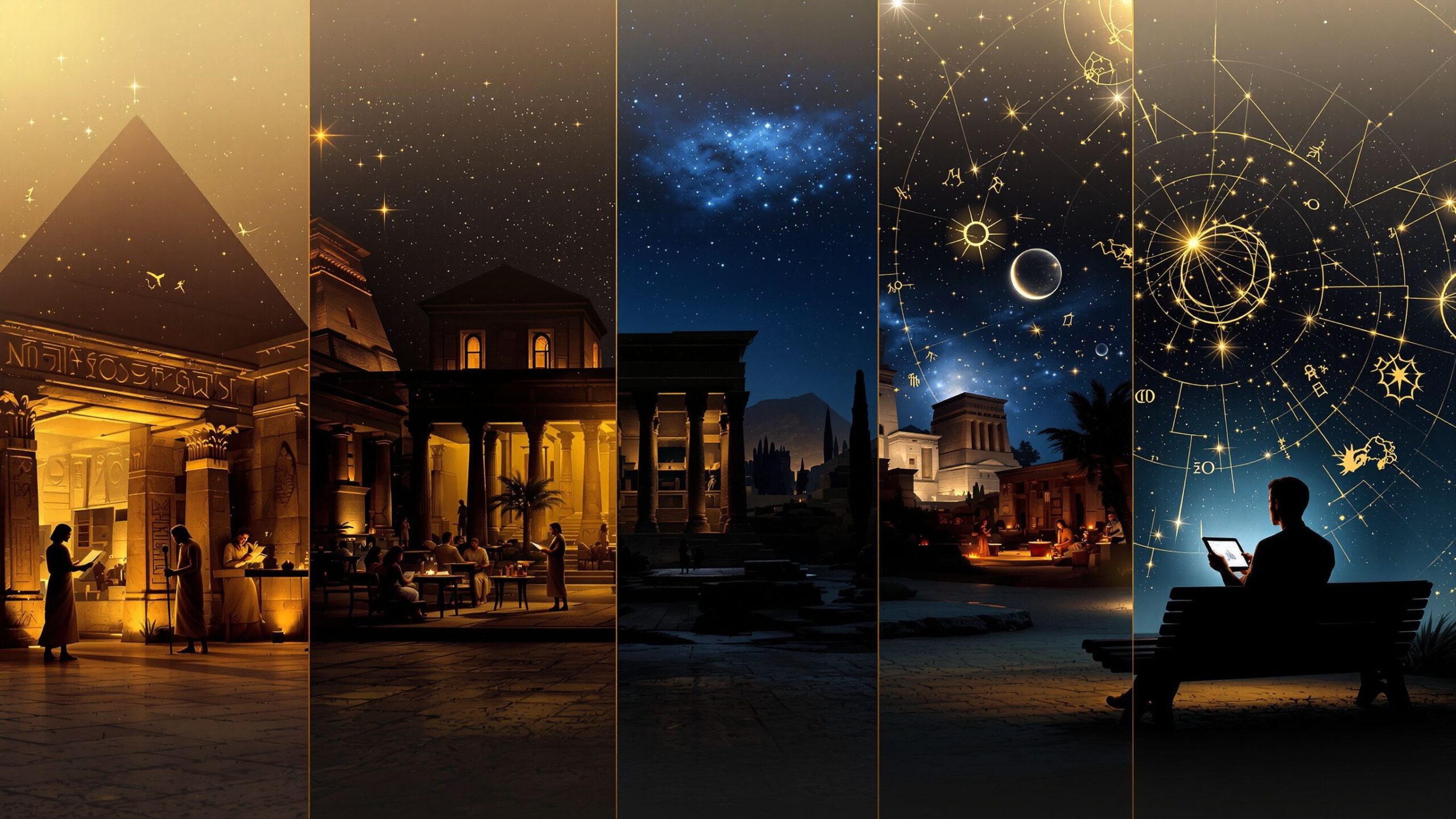
The story of the zodiac is a sweeping journey across thousands of years, civilizations, and human curiosity about the cosmos. Long before telescopes and modern astronomy, people looked to the night sky not just with wonder, but with purpose. The stars were not random points of light; they were guides, storytellers, and symbols of something greater. The zodiac, as we know it today, emerged from this deep-rooted fascination—a structured map of the heavens that blended observation, mythology, and meaning. Understanding how astrology began means tracing humanity’s earliest attempts to make sense of the universe and our place within it.
A: The zodiac’s roots are strongly connected to ancient Mesopotamia, especially Babylonian sky observation.
A: The sky path was divided into 12 equal sections, connected to the yearly solar cycle and ancient calendar systems.
A: They were once closely linked, but modern astronomy is a science while astrology is symbolic and interpretive.
A: It tracks the Sun’s apparent path through the sky, along with planetary movement through zodiac signs.
A: No, but Greek thinkers helped shape astrology into a more philosophical and chart-based system.
A: Many signs came from ancient constellations, myths, animals, and symbolic seasonal images.
A: A birth chart maps the positions of the Sun, Moon, planets, and zodiac signs at the time of birth.
A: Tropical astrology follows the seasons, while sidereal astrology uses star-based zodiac positioning.
A: It blends personality, storytelling, ancient history, symbolism, and cosmic curiosity.
A: Ophiuchus is a constellation on the ecliptic, but it is not part of the traditional 12-sign zodiac.
Ancient Beginnings: Watching the Sky
The origins of the zodiac can be traced back to ancient civilizations that carefully observed the sky for patterns. These early astronomers did not separate science from spirituality. Instead, the movements of celestial bodies were seen as direct influences on earthly events. In regions like Mesopotamia, Egypt, and the Indus Valley, the sky became a canvas filled with signs and messages.
Among these early cultures, the people of Mesopotamia—particularly the Babylonians—played a crucial role in shaping what would eventually become the zodiac. As early as the second millennium BCE, Babylonian scholars began tracking the movements of the sun, moon, and planets. They noticed that these celestial bodies followed a specific path across the sky, known today as the ecliptic. This path would become the foundation of the zodiac.
Babylonian Innovation: The Birth of the Zodiac System
The Babylonians were the first to divide the sky into recognizable segments that corresponded with constellations. Around the 5th century BCE, they established a system of twelve divisions along the ecliptic, each associated with a constellation. These divisions formed the earliest version of the zodiac.
Each of these twelve segments represented a period of the year and was linked to seasonal cycles. This connection between the heavens and earthly timekeeping was essential for agriculture and survival. Farmers relied on celestial patterns to determine when to plant and harvest, while rulers used astrology to guide decisions and predict outcomes.
The Babylonian zodiac included many constellations that are still familiar today, such as Aries, Taurus, and Gemini. However, their interpretations and symbolic meanings were deeply tied to their own mythology and cultural beliefs. What mattered most was not just the position of the stars, but what those positions signified.
Egyptian Influence: Aligning Stars with Life
While the Babylonians laid the structural foundation, ancient Egypt contributed a spiritual and symbolic dimension to the development of astrology. Egyptian astronomers created star charts and aligned temples with celestial events, demonstrating a profound respect for the cosmos.
The Egyptians were particularly focused on the star Sirius, whose rising signaled the annual flooding of the Nile—a vital event for their civilization. This connection between celestial events and life on Earth reinforced the belief that the stars held powerful influence over human destiny.
Egyptian astrology also introduced the idea of divine connection. The gods were often associated with celestial bodies, and the movements of these bodies were interpreted as expressions of divine will. This belief would later merge with other systems, enriching the symbolic depth of the zodiac.
Greek Transformation: From Observation to Philosophy
The zodiac as we recognize it today owes much to ancient Greece. When Greek scholars encountered Babylonian astrology, they did not simply adopt it—they transformed it. Greek thinkers approached astrology with a philosophical mindset, seeking to understand not just how the stars moved, but why they mattered.
One of the most influential figures in this transformation was Claudius Ptolemy, whose work “Tetrabiblos” became a cornerstone of Western astrology. Ptolemy organized astrological knowledge into a coherent system, linking celestial movements to human traits and behaviors. He emphasized the idea that the positions of the planets at the time of a person’s birth could influence their personality and life path.
The Greeks also formalized the twelve zodiac signs as symbolic archetypes. Each sign was associated with specific qualities, elements, and ruling planets. This system created a framework that allowed astrology to be used not only for predicting events, but for understanding human nature.
The Zodiac Signs: Symbols of Human Experience
The twelve zodiac signs represent more than just constellations; they are symbolic expressions of human experience. Each sign embodies a unique set of characteristics, reflecting different aspects of personality and life.
Aries, the first sign, represents beginnings and bold energy, while Taurus symbolizes stability and material comfort. Gemini captures communication and duality, and Cancer reflects emotional depth and nurturing instincts. Leo shines with confidence and creativity, while Virgo emphasizes precision and practicality.
Libra seeks balance and harmony, Scorpio delves into transformation and intensity, and Sagittarius explores freedom and knowledge. Capricorn represents ambition and discipline, Aquarius embodies innovation and individuality, and Pisces reflects intuition and compassion.
These archetypes were not randomly assigned. They were shaped by centuries of observation, storytelling, and philosophical interpretation. Together, they form a complete cycle that mirrors the journey of life.
Roman Expansion: Astrology Spreads Across Empires
As the Roman Empire expanded, so did the reach of astrology. The Romans embraced the zodiac and integrated it into their culture, often associating it with their own gods and traditions. Astrology became a popular practice among both the elite and the general population.
Roman emperors consulted astrologers for guidance, and horoscopes became a common tool for decision-making. This widespread acceptance helped solidify astrology’s place in Western society. The zodiac was no longer just a tool for observation—it had become a language for understanding fate and destiny.
Medieval Preservation: Keeping the Knowledge Alive
During the Middle Ages, astrology faced challenges as religious institutions questioned its legitimacy. However, it did not disappear. Instead, it was preserved and developed in the Islamic world, where scholars translated and expanded upon Greek and Roman texts.
Islamic astronomers made significant contributions to the study of celestial movements, refining calculations and improving observational techniques. Their work ensured that astrological knowledge continued to evolve, even as it faced skepticism in other parts of the world.
Eventually, this knowledge returned to Europe during the Renaissance, sparking renewed interest in astrology and the zodiac.
Renaissance Revival: Astrology Meets Art and Science
The Renaissance was a period of rediscovery, where ancient knowledge was brought back into the spotlight. Astrology flourished during this time, blending with art, science, and philosophy. Many prominent figures, including astronomers and artists, engaged with astrological concepts.
Astrology was seen as a legitimate field of study, closely linked to astronomy. The zodiac appeared in artwork, architecture, and literature, reflecting its cultural significance. People sought to understand not only the physical universe, but the deeper connections between the cosmos and human life.
Modern Astrology: A New Perspective
In the modern era, astrology has evolved into a more personal and introspective practice. While it is no longer considered a scientific discipline, it continues to hold cultural and emotional significance for millions of people around the world.
Today, the zodiac is often used as a tool for self-reflection. Horoscopes provide guidance, while birth charts offer insights into personality and relationships. The focus has shifted from predicting external events to understanding internal experiences.
Despite advancements in science and technology, the appeal of astrology remains strong. The zodiac continues to resonate because it speaks to something timeless—the human desire to find meaning and connection.
The Enduring Legacy of the Zodiac
The history of the zodiac is a testament to humanity’s enduring fascination with the stars. From ancient Babylonian astronomers to modern-day horoscope readers, the zodiac has evolved while maintaining its core purpose: to connect the cosmos with human life.
It is not just a system of signs or a method of prediction. It is a reflection of our collective imagination, our need for structure, and our search for identity. The zodiac bridges the gap between the physical and the symbolic, offering a way to interpret the mysteries of existence.
As we continue to explore the universe with advanced technology, the zodiac reminds us of where it all began—with people looking up at the night sky, asking questions, and finding meaning in the patterns above.
A Timeless Connection Between Sky and Self
The zodiac’s journey from ancient observation to modern interpretation is a story of curiosity, creativity, and continuity. It has adapted to changing cultures and beliefs, yet its essence remains the same. It is a map of the heavens, but also a mirror of the human soul.
Astrology began as a way to understand the world, and it continues to serve that purpose in new and evolving ways. Whether viewed as a science, an art, or a symbolic language, the zodiac holds a unique place in human history. In the end, the zodiac is not just about the stars—it is about us.