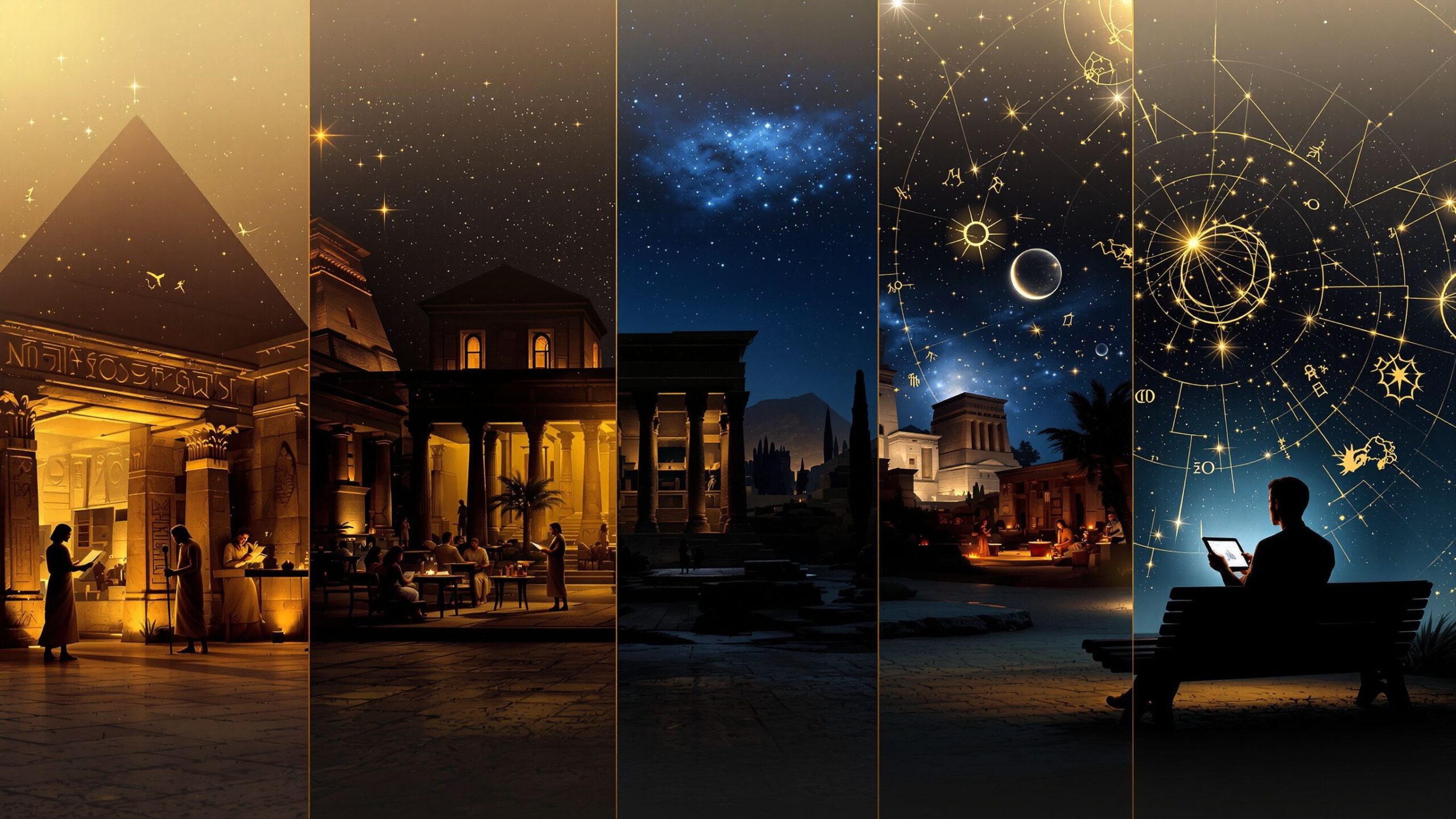
The zodiac is not a static invention frozen in time—it is a living system that has evolved alongside humanity. From its earliest beginnings in ancient civilizations to its modern role in personal reflection, the zodiac has continuously adapted to new cultures, beliefs, and understandings of the universe. Its journey is one of transformation, resilience, and reinvention. To understand the zodiac today, we must explore how it grew from simple sky observations into a deeply symbolic language that continues to shape how people interpret themselves and the world around them.
A: It began with ancient sky observation, became a 12-sign system, developed into birth-chart astrology, and later entered modern pop culture.
A: Mesopotamian and Babylonian traditions played a major role in creating the early zodiac framework.
A: Greek astrologers added philosophical structure, elements, houses, birth charts, and deeper personality interpretation.
A: Birth charts allowed astrologers to connect planetary positions with individual lives, character, timing, and destiny.
A: Yes, ancient sky study combined observation, mathematics, religion, symbolism, and prediction before the fields separated.
A: Sun signs became popular because they are simple, easy to calculate, and perfect for newspapers, magazines, and websites.
A: Uranus, Neptune, and Pluto added new symbolic meanings to modern astrology.
A: Tropical astrology follows the seasons, while sidereal astrology follows star-based positioning.
A: Yes. Astrology continues to evolve through apps, social media, wellness culture, psychology, and modern storytelling.
A: It connects time, myth, identity, personality, history, and the mystery of the night sky.
Ancient Foundations: Mapping the Heavens
The story of the zodiac begins with humanity’s first attempts to make sense of the night sky. In ancient times, the stars were not merely decorative—they were essential. People relied on them for navigation, agriculture, and timekeeping. Over generations, careful observation revealed patterns in the movement of celestial bodies.
In ancient Mesopotamia, particularly among the Babylonians, this observation became systematic. Scholars recorded the positions of the sun, moon, and planets, noting their regular paths across the sky. This path, later called the ecliptic, became the backbone of the zodiac system.
By dividing the ecliptic into twelve equal sections, the Babylonians created the first structured zodiac. Each section corresponded to a constellation, forming a calendar that aligned celestial movements with seasonal cycles. This innovation marked the beginning of astrology as an organized practice.
Myth and Meaning: Turning Patterns into Stories
As the zodiac took shape, it was infused with meaning through mythology. Ancient cultures did not simply chart the stars—they interpreted them. Constellations became symbols of gods, animals, and heroes, each carrying stories that reflected cultural values and beliefs.
These myths served multiple purposes. They made the sky easier to remember, provided explanations for natural events, and connected human life to the divine. The zodiac became a bridge between observation and imagination, turning the heavens into a narrative filled with meaning.
This blending of science and storytelling is one of the reasons the zodiac has endured. It speaks not only to logic but also to emotion and creativity.
Egyptian and Early Cultural Influences
While Mesopotamia provided the structural framework, ancient Egypt contributed a sense of cosmic harmony. Egyptian astronomy emphasized the connection between celestial events and life on Earth. The rising of certain stars, such as Sirius, was linked to important events like the flooding of the Nile.
Egyptian beliefs reinforced the idea that the universe operated according to a divine order. This perspective influenced later interpretations of the zodiac, emphasizing balance, cycles, and interconnectedness.
Other cultures also developed their own astrological systems. In India, astrology became deeply integrated into spiritual practices, while in China, a separate zodiac system emerged based on lunar cycles and animal symbols. Although different in form, these systems shared a common belief in the relationship between the heavens and human life.
Greek Refinement: Astrology Becomes a System
The zodiac underwent a major transformation when it reached ancient Greece. Greek scholars adopted Babylonian astrology and expanded it into a more philosophical and structured system. They sought to understand not just how the stars moved, but how those movements related to human behavior.
One of the most influential figures in this process was Claudius Ptolemy, whose writings organized astrological knowledge into a coherent framework. He introduced the idea that the positions of celestial bodies at the time of birth could shape personality and destiny.
The Greeks also formalized the twelve zodiac signs as archetypes, each associated with specific traits, elements, and ruling planets. This system added depth and consistency, making astrology more accessible and widely understood.
Roman Adoption: Astrology for the Masses
As the Roman Empire expanded, astrology spread throughout Europe. The Romans embraced the zodiac and incorporated it into their daily lives. It became a tool for decision-making, guidance, and even political strategy.
Astrologers were highly valued, and horoscopes became increasingly popular. The zodiac was no longer limited to scholars and elites—it reached the general population. This widespread adoption ensured its survival and continued influence.
Roman culture also helped standardize the zodiac signs and their symbols, many of which remain unchanged today. The zodiac had become a shared language across a vast empire.
The Middle Ages: Preservation and Transformation
The fall of the Roman Empire brought challenges for astrology in Europe, as religious institutions often viewed it with suspicion. However, the zodiac did not disappear. Instead, it was preserved and further developed in the Islamic world.
Islamic scholars translated ancient texts and made significant advancements in astronomy. They refined calculations, improved observational tools, and expanded knowledge of celestial movements. This work kept astrology alive during a time of cultural transition.
When these ideas returned to Europe during the Renaissance, they reignited interest in the zodiac and its applications.
The Renaissance: A Golden Age of Astrology
The Renaissance marked a revival of interest in classical knowledge, including astrology. During this period, astrology was considered a legitimate field of study, closely linked to astronomy. Scholars, artists, and thinkers explored the zodiac as both a scientific and philosophical system.
The zodiac appeared in artwork, architecture, and literature, reflecting its importance in cultural life. People saw it as a way to understand the harmony between the cosmos and human existence.
This era solidified the zodiac’s place in Western thought, blending ancient traditions with new discoveries.
The Scientific Shift: Astrology and Astronomy Divide
As science advanced, astronomy and astrology began to separate. The development of the scientific method led to a focus on empirical evidence and measurable data. Astronomy evolved into a scientific discipline, while astrology moved into the realm of symbolism and personal interpretation.
Despite this shift, the zodiac did not fade away. Instead, it adapted. Its role changed from predicting external events to offering insights into personality and relationships.
This transition allowed the zodiac to remain relevant, even in a world increasingly driven by science.
Modern Astrology: A Tool for Self-Discovery
Today, the zodiac is widely used as a tool for self-reflection and personal growth. People explore their zodiac signs to better understand their strengths, challenges, and relationships. Birth charts provide a more detailed analysis, mapping the positions of celestial bodies at the time of birth.
Astrology has become deeply integrated into popular culture, appearing in social media, apps, and daily horoscopes. While it is often approached with a sense of curiosity rather than strict belief, it continues to resonate with millions of people.
The modern zodiac emphasizes introspection and emotional awareness, reflecting the values of contemporary society.
The Zodiac’s Enduring Appeal
What makes the zodiac so enduring is its ability to evolve without losing its essence. It has adapted to different cultures, philosophies, and scientific understandings, yet it remains rooted in the same fundamental idea: that the cosmos and human life are connected.
The zodiac provides a framework for understanding complexity. It offers symbols that capture the diversity of human experience, allowing individuals to find meaning in their lives.
Its flexibility is its strength. The zodiac can be interpreted in countless ways, making it accessible to people from all backgrounds.
Conclusion: From Ancient Stars to Modern Souls
The evolution of the zodiac is a story of transformation and continuity. It began as a practical tool for tracking celestial movements and grew into a symbolic system that reflects the human experience. Across centuries and civilizations, it has been shaped by observation, mythology, philosophy, and culture.
Today, the zodiac continues to inspire curiosity and reflection. It reminds us that even as our understanding of the universe changes, our desire to find meaning within it remains constant.
From ancient stargazers to modern seekers, the zodiac has always been more than a map of the sky—it is a mirror of humanity itself.