Before Modern Disciplines Drew Their Boundaries
Astronomy and astrology historically overlapped because calculating celestial motion, preparing calendars, and interpreting the sky could belong to the same scholar’s training or employment. Their relationship becomes clearer through actual examples: Ptolemy organized both mathematical astronomy and astrological theory in the second century; Ibn Yunus combined meticulous observations with predictive writing in medieval Egypt; Renaissance universities and courts supported practitioners whose duties crossed today’s boundaries. This was neither one identical field everywhere nor a single worldwide discipline that split on a particular day. The examples below trace changing tasks and institutions rather than claiming a complete global history. They show why the same numerical expertise could serve different purposes, and why a useful calculation does not establish every interpretation attached to it. The shared past explains the connection; the evidence required for modern claims explains the distinction.
Practical Timekeeping Made the Sky Worth Studying
Long before modern research institutions, recurring celestial patterns helped people organize time. The apparent daily movement of the Sun, the changing Moon, and seasonal patterns among the stars supplied reference points that could be observed repeatedly. A community did not need a modern theory of the solar system to recognize that those patterns were useful. Improving records and calculations could serve ordinary practical needs as well as more specialized scholarly interests.
Once a pattern mattered for calendars or institutions, there were reasons to preserve and teach the knowledge required to follow it. Observations could be compared across years, methods could be transmitted between generations, and specialists could acquire authority through their ability to anticipate celestial events. The social value of the work helped support its continuation. That setting is important because the history concerns not only ideas, but also the people and institutions willing to maintain them.
Practical usefulness did not mean every associated interpretation was equally reliable. A successful calendar calculation and an omen attached to the same sky could coexist in one tradition. The historian’s task is to understand that coexistence without pretending the claims were identical. The modern reader’s task is to avoid importing today’s categories so rigidly that the historical setting becomes impossible to recognize.
Second-Century Ptolemy Wrote Different Kinds of Celestial Work
Claudius Ptolemy’s Almagest organized mathematical astronomy, while his Tetrabiblos set out astrological arguments. Cambridge’s account of the latter describes it as a companion study concerned with celestial influences. That is a specific example of intellectual connection without identical tasks: determining a position and explaining an alleged influence remained distinguishable activities. Ptolemy also tried to delimit the practices he defended rather than accepting every form of divination. His effort to organize astrology rationally is evidence about his project and worldview, not a modern demonstration of its predictive claims. Looking at the two works together explains more than assigning their author just one present-day professional label.
Medieval Egypt: Ibn Yunus Shows the Breadth of One Career
Ibn Yunus, who died in 1009, made observations in Fatimid Egypt and compiled the Hakimi Zij, a substantial astronomical handbook with tables. The Cambridge biography identifies observations made between 977 and 1003 and emphasizes the handbook’s recorded observational basis. This supplies a concrete setting for the relationship between calculation, state patronage, and accumulated evidence. The work was not simply a modern horoscope column with an older date.
The same scholar also wrote predictions. A separate Cambridge discussion of his astrology describes a text interpreting Sirius’s heliacal rising and calendrical circumstances. Putting the two records side by side prevents two opposite mistakes: dismissing the observations because he practiced astrology, or treating his observational achievements as proof of his forecasts. A career can connect activities without making every resulting claim equally well supported.
Mathematics Supported Several Kinds of Work
Calculating celestial positions required increasingly sophisticated techniques. Those techniques could support calendar making, observational planning, and astrological chart construction. A patron interested in forecasts might therefore support the same mathematical expertise that improved descriptions of planetary motion. This is one reason the later scientific importance of a calculation cannot be separated neatly from every historical use that helped fund or motivate it.
The overlap also explains why modern judgments about a historical scholar can become confused. An individual might make valuable contributions to mathematical astronomy while holding beliefs about celestial influence that would not count as established science today. Recognizing both facts is more accurate than either dismissing the contribution or treating the contribution as proof of the associated belief. People and institutions rarely fit cleanly into retrospective labels.
Historians can examine the actual work to understand the balance. Was the author deriving positions, improving an instrument, interpreting a birth chart, or discussing a philosophical account of influence? Those activities can appear in the same career without being interchangeable. Specific evidence about the task is more useful than a broad assumption based on a person’s reputation.
Instruments Embodied the Overlap
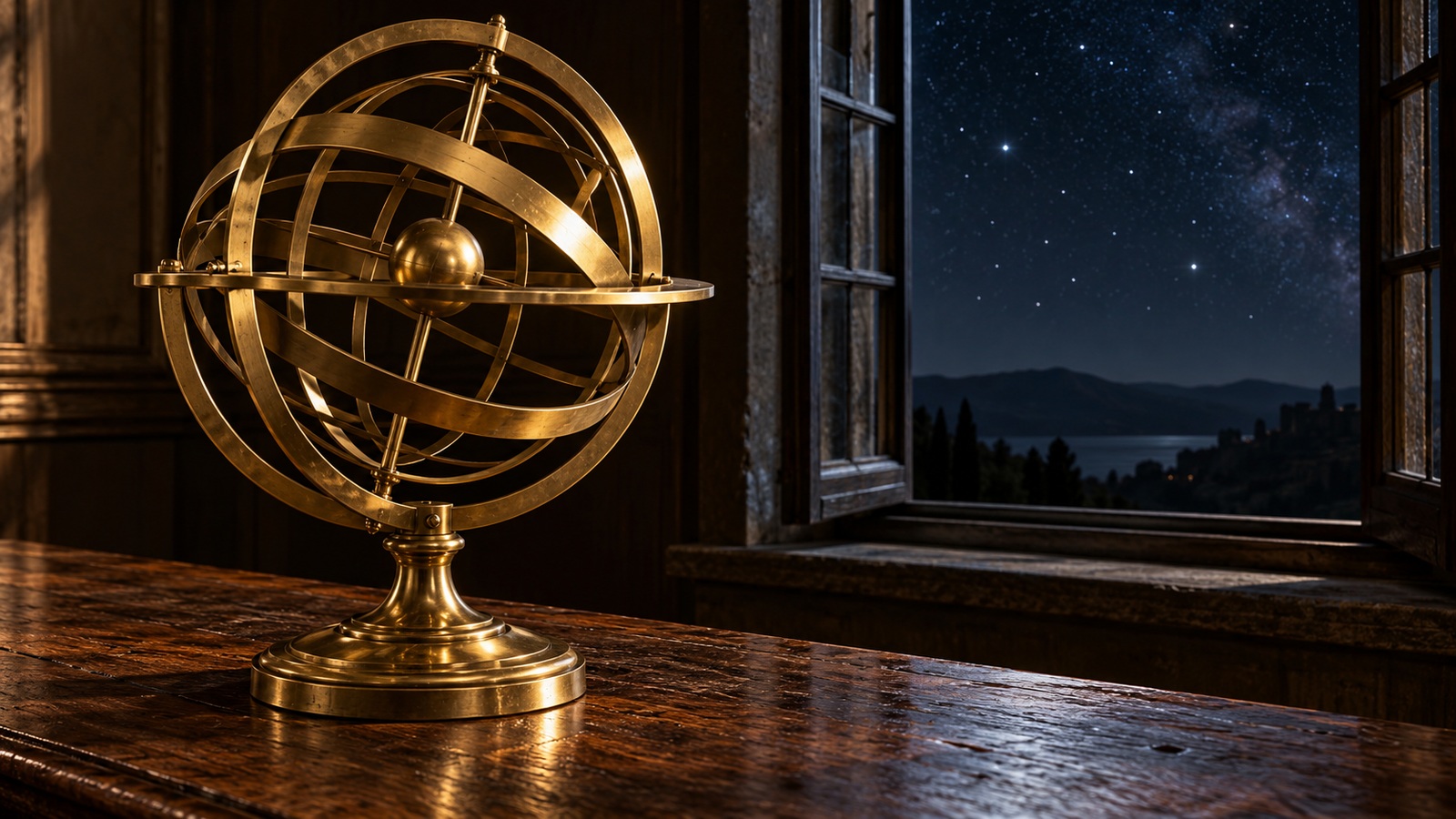
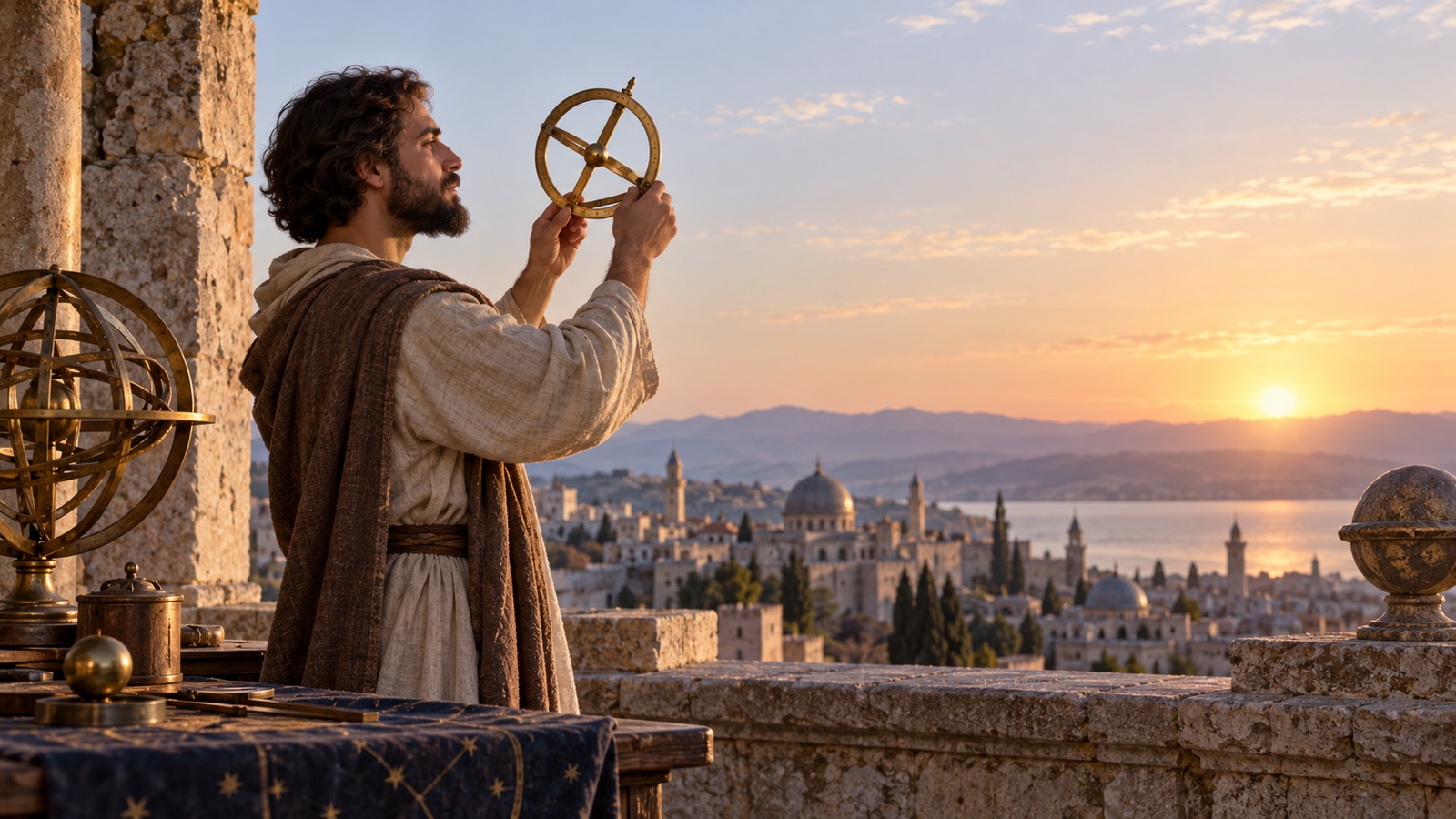
An astrolabe is a useful example of an object whose history crosses modern boundaries. Its geometry supported celestial and timekeeping tasks, while its cultural settings could include astrology, religion, education, and status. The History of Science Museum’s exhibition on astrolabes presents that range across cultures. An instrument’s appearance alone cannot tell the whole story of its purpose. Its construction, inscriptions, users, and documented setting all contribute evidence. Looking at the object this way replaces a simplistic category with a more concrete account of what people could actually do with it.
| Documented anchor | What it establishes | What remains separate |
|---|---|---|
| The Oxford exhibition identifies a Regnerus Arsenius astrolabe made in Louvain in 1565 | A named maker, place and date for a surviving instrument | The particular reasons each historical owner used it |
| The exhibition groups instruments through geometry and several cultural themes | Multiple historical roles merit investigation | A claim that every object served every role equally |
Tables Traveled Between Languages and Users
The Toledan Tables provide an example of transmission rather than a vague claim that knowledge crossed cultures. The Cambridge tables history describes their eleventh-century compilation from several inherited sources and twelfth-century Latin translation. Such movement made mathematical resources available in new scholarly settings. Users could adapt a method to local coordinates, calendars, and purposes rather than receiving a single unchanged package of beliefs.
Later printed ephemerides reduced repeated calculation by supplying positions ready for use. That mattered to readers preparing charts as well as to other users of celestial information. Tables are therefore part of the explanation for historical overlap: the same numerical infrastructure could support more than one activity. Our guide to astronomy–astrology connections follows this transfer between numerical data and chart notation. Here its historical significance is the circulation of expertise among audiences with different needs.
Bologna’s Prognostications Made the Institutional Link Explicit
At the University of Bologna, from 1404 the professor of mathematics and astrology was required to issue annual prognostications, according to Cambridge’s account of Copernicus’s intellectual setting. Domenico Maria’s publications combined items such as Easter and eclipse timings with forecasts. This is an identifiable employment arrangement, not a guess that every medieval university taught the same curriculum. One office brought calculation and prognostication together because its audience expected both. Its contents also show why the word “prediction” needs care: forecasting an eclipse and forecasting a social outcome are different claims even when printed by one author.
Kepler Connected Physical Astronomy With Court Astrology
Johannes Kepler became Imperial Mathematician in 1601 and published his work on Mars and elliptical orbits in 1609. The Cambridge biography places these achievements alongside court service and the need to secure support. His career makes patronage concrete: mathematical research occurred within a livelihood and institutional setting, not outside society.
Kepler’s astrological activity was also more than an embarrassing footnote or a purely commercial disguise. Cambridge’s account of his astrological writing identifies his effort to reform its foundations in 1601 and his continuing horoscope work. He criticized practices while defending forms of celestial influence he thought defensible. That combination complicates an easy story in which improved astronomy automatically caused every practitioner to abandon astrology.
His example does not mean modern scientific astronomy must accept those influences. It shows that a person can contribute a successful physical model while holding additional beliefs that require separate assessment. The historical explanation concerns how those projects belonged together in his working world. The modern assessment concerns what evidence supports each claim. Neither task is improved by erasing the other.
Why There Was No Universal Day of Separation
Different places maintained different institutions, popular traditions, and intellectual priorities. Even within one region, scholarly criticism, public belief, and everyday commercial publishing could move in different directions. It is therefore misleading to search for one date when everyone stopped treating astronomy and astrology as connected. The change was uneven and involved debates about knowledge, causation, authority, and what kinds of predictions could be supported. A broad period can help orient the reader, but the local evidence determines what actually changed for a particular practice or institution.
Read Historical Labels With Care
Words such as astronomer, astrologer, mathematician, and natural philosopher have not always carried their present meanings. An old text’s label should be interpreted in its setting rather than translated automatically into a modern professional identity. Ask which activities the person performed and how contemporaries understood those activities. A modern description can still be useful, provided it clarifies rather than erases the historical difference.
That caution also applies to the phrase “once the same field.” It expresses a real historical closeness, but it can conceal diversity and disagreement. A more precise formulation is that celestial observation, mathematical calculation, and astrological interpretation often overlapped within earlier traditions of sky knowledge. This account explains the connection while leaving room for historical distinctions and the later development of different evidence standards.
A Small Chronology Explains More Than a Single Split Date
The cases form a limited route through several settings rather than a universal sequence every culture followed. Ptolemy illustrates linked intellectual projects; Ibn Yunus shows observations and prediction in one Egyptian career; translated tables show transmission; Bologna shows an institutional duty; Kepler shows research and astrology continuing together during major changes in planetary explanation. Each case identifies a different reason the activities remained connected.
| Period or date | Example | Connection demonstrated |
|---|---|---|
| Second century | Ptolemy’s astronomical and astrological works | Related but distinguishable intellectual projects |
| 977–1003 | Ibn Yunus’s recorded observations | Observation within a broader scholarly career |
| Twelfth century | Latin translation of Toledan Tables | Methods entering new contexts |
| From 1404 | Bologna’s annual prognostications | One office serving mixed expectations |
| 1601 and 1609 | Kepler’s astrological reform and Mars research | Physical innovation alongside continuing interpretation |
Notice what the chronology does not establish. It supplies no date when all regions abandoned astrology, and no reason to suppose that every owner of an instrument used it identically. The social organization of knowledge can preserve an older activity while another develops different methods. That is why the historical overlap and the present distinction can both be true.
For the modern evidence question, use our astronomy versus astrology comparison. For history, keep the cases attached to their works, places, and dates. The result is a more precise account of shared expertise, employment and information than the phrase “once the same field” can carry by itself. It leaves historical achievements visible without asking their authors to fit present-day departments or lending every associated forecast scientific authority.