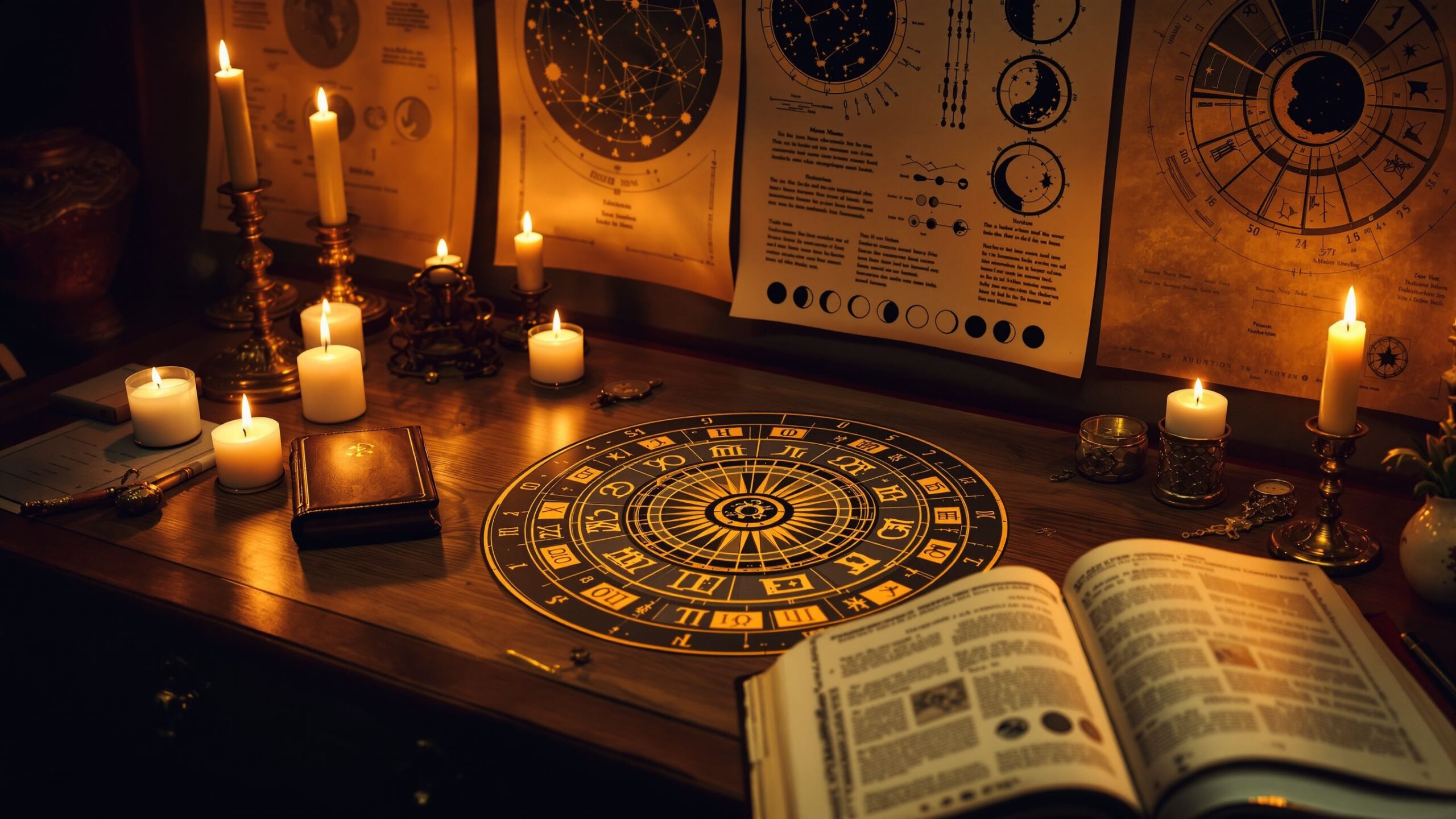
Every birth chart in astrology is a universe of details, and one of its most precise elements is degrees. Degrees might look like small numbers next to planets and signs, but they are among the most revealing parts of your chart. Each zodiac sign spans thirty degrees, making the full circle of the zodiac 360 degrees. These tiny measurements mark the exact position of every planet at the time you were born. In astrology, precision matters—a planet at 2° Aries expresses differently than one at 28° Aries. Degrees define nuance, flavor, and timing. They are the cosmic coordinates that show not just what sign your planet is in, but how powerfully that energy expresses itself.
A: They tell you exactly where each planet is located in a sign, offering precision.
A: A degree believed to carry intensified, fated, or urgent energy.
A: A symbolic image linked to each zodiac degree, offering insight.
A: 0° is a beginning, fresh energy. 29° is an ending or mastery.
A: Yes—this is called a conjunction and makes their energies merge strongly.
A: Because exact aspects or placements make interpretations more potent.
A: Yes—tight degree connections often indicate strong bonds or triggers.
A: It’s the 29th degree of any sign, often signaling urgency or completion.
A: It represents a fresh start with that planet’s energy—pure and untamed.
A: Some astrologers believe so, but it depends on context and chart dynamics.
The Zodiac Wheel and the 360 Degrees of the Sky
Imagine the zodiac wheel as a celestial circle divided into twelve equal slices—one for each sign of the zodiac. Each sign holds 30 degrees, measured from 0° to 29°. Together, these make up the 360° of the sky. When astrologers cast a birth chart, they mark the position of the planets within these degrees to capture the exact cosmic moment of your birth. For instance, a Sun at 10° Leo means the Sun was ten degrees into the sign of Leo when you were born, radiating that sign’s creative, confident essence. A Moon at 27° Scorpio has absorbed nearly all the intensity of Scorpio’s transformative energy. The closer a planet is to the beginning or end of a sign, the more distinct its expression becomes—degrees are what fine-tune astrology’s language into precision.
Understanding the Role of Degrees
Degrees add layers to astrological interpretation. They influence strength, sensitivity, timing, and connection between planets. A planet’s degree determines how it interacts with others through aspects—angles measured by degree distances. These aspects define harmony or tension in your chart. Degrees are also essential for tracking transits—when moving planets form exact alignments with your natal placements. A one-degree difference can mean the shift between reflection and transformation. While signs describe general energy, degrees pinpoint when and where that energy activates in your life.
The Power of the Early, Middle, and Late Degrees
Every sign’s 30 degrees carry a subtle evolution from beginning to end. The early degrees (0°–9°) represent initiation and raw energy. Planets here express the purest form of their sign’s traits—untamed, direct, and unfiltered. The middle degrees (10°–19°) show stability and full embodiment of the sign’s essence. Energy flows more naturally here, confident and self-assured. The late degrees (20°–29°) carry mastery, wisdom, and sometimes fatigue of the sign’s energy. These placements often feel seasoned—like old souls within that sign’s domain. For instance, Mars at 3° Aries acts impulsively and boldly, while Mars at 27° Aries carries experience, focus, and deeper self-awareness of the same fire.
The Critical Degrees: Turning Points of Power
Some degrees hold special significance—they’re called critical degrees because they heighten a planet’s influence. In traditional astrology, these are considered points of intensity or transformation. For the cardinal signs (Aries, Cancer, Libra, Capricorn), the critical degrees are 0°, 13°, and 26°. For fixed signs (Taurus, Leo, Scorpio, Aquarius), they are 8°–9° and 21°–22°. For mutable signs (Gemini, Virgo, Sagittarius, Pisces), they are 4° and 17°. When a planet lands on one of these degrees, it amplifies that planet’s energy, often giving it greater visibility or purpose in your life. A Sun at a critical degree may indicate a powerful personality; a Moon there may reveal emotional depth or psychic sensitivity. These placements mark moments of heightened cosmic emphasis—like exclamation points in your chart.
The Anaretic Degree: The 29th Degree of Completion
Among all degrees, the 29th degree—known as the Anaretic Degree—is the most charged and mysterious. It represents the final degree of any sign, carrying the energy of culmination, mastery, and urgency. When a planet sits at 29°, it has absorbed nearly all the lessons of that sign and is preparing to transition into the next. This creates intensity—a sense of unfinished business or a push toward evolution. A planet at 29° Leo may crave one last moment in the spotlight before stepping into Virgo’s practical energy. The Anaretic Degree often appears in charts during pivotal life themes—closure, maturity, and transformation. It can feel like standing at the edge of a threshold, knowing something profound is about to change.
The Zero Degree: Beginnings and Pure Potential
Just as 29° marks an ending, 0° marks a beginning. A planet at 0° of any sign represents fresh energy—untested, pure, and full of potential. This degree holds the spirit of new birth, the blank page before the story begins. A Sun at 0° Libra radiates the first breath of balance and partnership, while a Moon at 0° Cancer carries the first wave of emotion and nurturing. These placements often bring enthusiasm, creativity, and spontaneity, but they may also lack experience. The 0° degree is the symbol of possibility—a cosmic sunrise signaling a new cycle.
The Decans: Degrees in Three Phases
Astrologers further divide each 30-degree sign into three sections called decans, each spanning 10 degrees. Each decan adds an extra layer of personality by blending influence from another sign of the same element. The first decan (0°–9°) carries the pure energy of the sign itself. The second decan (10°–19°) mixes traits from the next sign of the same element. The third decan (20°–29°) blends qualities of the final sign in that element’s group. For example, in Aries, the first decan (0°–9°) is ruled by Mars—bold and direct. The second decan (10°–19°) is ruled by the Sun—radiant and confident. The third decan (20°–29°) is ruled by Venus—passionate and creative. Decans bring complexity, explaining why two people with the same Sun sign can express it so differently.
How Degrees Affect Aspects
Aspects—the geometric relationships between planets—are defined by degrees. A conjunction forms when two planets are within 0°–10° of each other, blending energies. A square occurs at 90° apart, creating tension that drives growth. A trine at 120° brings harmony, and an opposition at 180° reveals polarity. The exactness of these degrees determines intensity. A trine that’s exact at 120° is stronger than one that’s a few degrees off. This precision shapes your chart’s emotional tone and life events. Even small degree differences between planets can shift timing or expression dramatically.
The Degrees and Timing of Life Events
Astrologers use degrees to track planetary motion and timing through transits and progressions. When a transiting planet forms an exact aspect—down to the degree—with one in your birth chart, that’s when events or realizations occur. These moments align with major turning points, opportunities, or challenges. For example, when Saturn transits the exact degree of your natal Sun, you might face responsibility, growth, or a test of endurance. The accuracy of degrees allows astrologers to make precise predictions and recognize repeating cycles across your lifetime. Degrees turn astrology into a science of timing as much as symbolism.
Degrees and Sabian Symbols
Each of the 360 degrees of the zodiac is associated with a unique image or phrase called a Sabian Symbol, developed in the 1920s by astrologer Marc Edmund Jones and clairvoyant Elsie Wheeler. These poetic descriptions give spiritual meaning to each degree. For example, the Sabian Symbol for 15° Aries is “An Indian weaving a blanket,” symbolizing creativity and tradition. The one for 22° Leo is “A carrier pigeon fulfilling its mission,” representing purpose and communication. Sabian Symbols allow astrologers to interpret degrees symbolically, adding a mystical layer to chart analysis. They remind us that each degree is not just mathematical—it’s alive with imagery and meaning.
Why Degrees Matter in Your Chart
Degrees are the hidden architecture of astrology. They reveal where your energy begins, matures, and transforms. They show when planetary forces activate and how intensely they express. Knowing the degrees of your Sun, Moon, and Rising helps you understand your life’s timing and temperament. For example, a Sun at 0° Sagittarius might express idealism in its purest form, while one at 29° Sagittarius might be wiser, ready to transition into Capricorn’s realism. These subtle distinctions make astrology deeply personal and endlessly nuanced.
How to Find the Degrees in Your Chart
You can find your degrees by generating a natal chart online using your birth date, exact time, and place. Each planet will appear with a number followed by a degree symbol (°) and a sign abbreviation—for instance, “Sun 17° Taurus” or “Moon 3° Gemini.” Those numbers are your degrees. You can then explore critical degrees, decans, and Sabian Symbols for deeper insight. The more precise your birth time, the more accurate your degrees and house positions will be.
The Deeper Meaning of Degrees
Degrees symbolize the unfolding of cosmic evolution within you. They represent the journey from the first spark of potential to the final moment of mastery. Every degree adds depth to your character, marking milestones of growth and awakening. The planets are like actors, the signs their costumes, and the degrees the stage direction—telling them exactly how to perform their role. When you learn to read degrees, astrology becomes not just an art of interpretation but a dialogue of precision, rhythm, and soul.
The Geometry of Destiny
Degrees are the heartbeat of astrology—the silent language of timing and transformation. They show where your life energy begins and where it culminates. A planet at 0° is the sunrise of possibility; one at 29° is the sunset of fulfillment. Between them lies the story of your becoming. Each degree marks a step in the dance between heaven and earth—a reminder that your life unfolds in exact alignment with cosmic rhythm. When you understand degrees, you don’t just read your chart—you feel the precision of the universe moving through you. The stars may guide, but the degrees tell the story of how, when, and why.